Trending

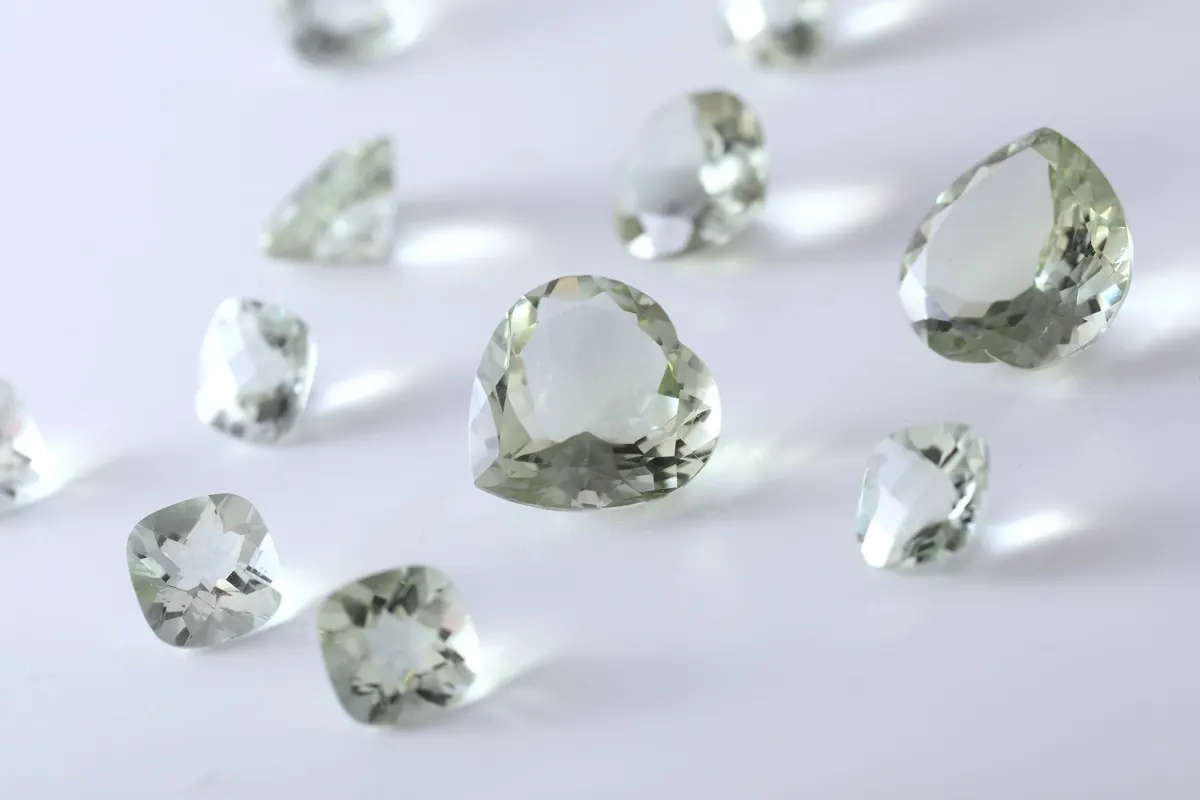
A gemstone's cut is the first thing your eye reads, usually before you have registered the colour. Two stones cut from the same rough can look like distant relatives: one blazing with white light, the other holding its colour in quiet, mirrored bands. Learn four basic silhouettes — brilliant, step, cabochon and mixed — and you can name most of what you see in a jeweller's window, and understand why the cutter chose it.
Shape and cut are not the same thing. Round, oval, pear, marquise, square and heart describe the outline; brilliant, step, cabochon and mixed describe how the surface is faceted. A pear can be a brilliant cut. A cushion can be either.
Every cut answers one question: how does light behave inside this particular piece of rough? Colour saturation, clarity and the stone's refractive index all push the cutter towards one arrangement of facets rather than another. For diamonds, cut is the only member of the four Cs decided by human hands rather than geology, which is why it has such an outsized effect on how a stone looks in the hand.
A round brilliant is the benchmark. It has 57 facets, or 58 with a small culet, arranged in a strict geometry: a large flat table on top, a crown of triangular and kite-shaped facets around it, a girdle at the widest point, and a pavilion below that bounces light back out through the crown.
Get the proportions right and you get three effects at once — brightness, fire and the flickering movement usually called scintillation. Get them wrong and the stone looks glassy or dark in the centre.
The brilliant idea travels well. Oval, marquise, pear, heart and cushion brilliants all use the same faceting logic on a different outline. Elongated shapes have one known weakness: a dark band across the middle, nicknamed a bow-tie, where light leaks out instead of returning. A well-cut oval or pear keeps that shadow narrow and soft.
Brilliants suit stones with a high refractive index and enough colour to survive all that white light — diamond, sapphire, ruby, spinel, tsavorite, zircon. Pale material can look watery beneath this much flash.
Step cuts stack flat, parallel facets in rows, like the tiers of a wedding cake. The classic is the emerald cut: rectangular, with the four corners clipped at 45 degrees. The clipping is not decoration. Sharp corners chip, and emeralds are brittle, so the shape protects the stone as much as it flatters it. Baguettes are simply narrow step cuts, often used as shoulder stones either side of a centre stone.
Look into a step cut and you see broad bands of colour sliding over one another — the "hall of mirrors" effect. There is nowhere to hide. Inclusions show up readily and weak colour looks washed out, which is why cutters reserve this style for clean, evenly saturated material: emerald, aquamarine, tourmaline, morganite, sapphire and coloured diamonds.
A cabochon has no facets at all. It is a polished dome, usually with a flat or slightly hollowed base, and it is often the most sensible choice rather than a lesser one. Faceting only works when light can pass through and return; many of the most beautiful stones in the trade are opaque, cloudy or full of inclusions that would shatter under a cutting wheel.
Cabochons are the natural home of:
Judge a cabochon on the dome: smooth, evenly curved, no flat spots, no dull patches, and a good polish. On a star or cat's eye stone, the line should be centred and sit at right angles to the length of the stone when viewed from above.
Mixed cuts combine a brilliant-style crown with a step-cut pavilion, or the reverse. The radiant cut is the standard example: brilliant faceting on top for sparkle, step facets underneath for deep, banded colour, and clipped corners for strength.
You will also meet square stones with brilliant-style chevron facets (the princess, usually classed as a modified brilliant) and triangular trillions, which are brilliant cuts on a three-sided outline. What mixed cuts give you is a stone that flashes when you move it but still holds its colour when you stop. That balance is why they have become so common in coloured stones, particularly sapphire and tourmaline.
You do not need a loupe to get most of the way there. Turn the stone under a lamp and work through these checks:
Shop lighting is designed to flatter. Take any stone to a window and look at it in daylight, then in shade. A well-cut stone keeps some life in both.
Ask what the cut is called, and check the symmetry: is the table centred, do the facet points meet cleanly, does the outline look even? Lopsided cutting shows up as dull patches that no setting can disguise. Run a fingertip gently around the girdle — an extremely thin, knife-edged girdle is more likely to chip in wear, and it needs a protective setting rather than a delicate one.
Think about the setting at the same time as the stone. Step cuts and cabochons usually look best with a simple surround that lets the stone speak; brilliants carry halos and side stones more comfortably. If the piece matters to you financially, ask for a grading report from a recognised laboratory or an independent gemmologist's opinion before you commit, and keep the paperwork for insurance.
One last thing: cut is not a detail to settle after you have chosen a colour. It decides how that colour behaves every time the stone catches the light. Buy the cut you enjoy looking at, and the rest tends to follow.
Photo: The Glorious Studio / Pexels