Trending

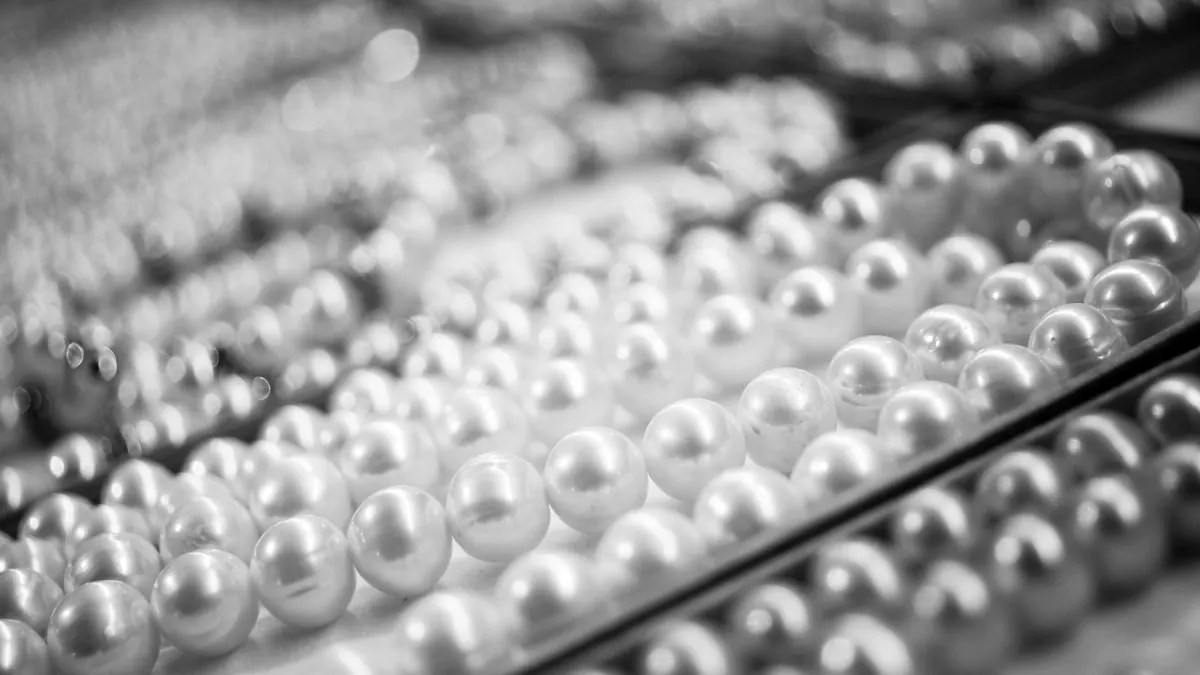
Two pearl strands can look near-identical in a photograph and sit at wildly different prices in the same shop window. The gap is not sales patter. It comes down to which mollusc grew the pearl, in what water, and how long it was left to develop. Learn the four main types and choosing a necklace, a pair of studs or a bracelet stops being a guessing game.
Almost every pearl on the UK high street belongs to one of four groups. Here is the short version before we look at each in detail.
Tahitian and South Sea pearls are both saltwater and both large, so they are often displayed together, but they come from different oysters in different oceans and behave differently on the skin. One common trap: dyed freshwater pearls sold as “black pearls”. Genuine Tahitian pearls are rarely jet black — most show clearly visible overtones.
Freshwater pearls grow in mussels in lakes and rivers, with China producing the overwhelming majority. Instead of a round bead nucleus, most are grown from a small piece of mantle tissue, so the pearl is solid nacre all the way through. That makes them surprisingly durable — and it explains their shapes: rounds, buttons, ovals, drops, rice and the irregular baroque forms designers love.
Freshwater lustre is softer and more satin-like than saltwater. A good strand still glows, but it rarely delivers the mirror-sharp reflection of an Akoya. Colours run from white and cream to pink, peach and lavender, and many dark freshwater pearls are dyed or irradiated — fine, as long as the seller says so. Bead-nucleated freshwater pearls, sometimes marketed as Edison pearls, can reach 10mm and beyond in a round shape, which makes them a strong budget alternative to South Sea.
Where they shine: bracelets, pendants, layered necklaces and earrings — anything you want to wear daily without worrying.
Akoya pearls come from small saltwater oysters, farmed mainly in Japan and increasingly in China and Vietnam. A round shell bead is inserted, and the oyster coats it with layer after layer of nacre. The result is the pearl most people picture when they hear the word: round, uniform, bright.
Akoya lustre is the sharpest of the four, often with a subtle overtone of rose, silver or green. Sizes cluster between 6mm and 9mm; anything above 9.5mm is uncommon and priced accordingly.
Two things worth knowing. Akoya nacre is comparatively thin — often well under a millimetre — so these pearls are less forgiving of rough wear than freshwater or South Sea. And because matching is labour-intensive, the price of a strand rises steeply with uniformity. If every pearl in a necklace is the same size, colour and overtone, you are paying for the sorting as much as for the pearls themselves.
Quick lustre test: hold the strand near a window. In a bright Akoya pearl you should see a crisp reflection of the window frame, not a soft blur.
Tahitian pearls grow in the black-lipped oyster in the lagoons of French Polynesia. They are usually 8mm to 14mm, with thick nacre and a metallic, almost oily lustre. The colours are the draw: peacock green, lagoon blue, pistachio, aubergine and cherry, typically layered over a grey body colour. Shapes run from round to drop, button and the distinctive circled baroque. Price climbs sharply with size, so a 12mm pair of studs costs many times a 9mm pair of the same quality.
South Sea pearls come from the silver-lipped and gold-lipped oysters of Australia, Indonesia and the Philippines. They are the largest farmed pearls, commonly 9mm to 16mm. White and silver-white are the classics; the golden pearls from the gold-lipped oyster are the most sought after, and the deeper and more saturated the gold, the more they command. Nacre is thick and the lustre is a deep, soft satin rather than a hard shine — in low light, a fine South Sea pearl seems to glow from within.
Pearls have no single universal grading system, so treat any scale as the seller’s own unless they explain it clearly. In practice, price is built from six things:
View them in daylight if you can, and compare two strands side by side rather than one at a time — differences in lustre show up immediately. Hold the pearls against your skin: bright white suits cooler skin tones, cream and gold suit warmer ones, and dark Tahitian colours flatter almost everyone.
Pearls are soft and dislike chemicals. Put them on last, after perfume and hairspray, and take them off first. Wipe them with a soft damp cloth, store them in a pouch or lined box rather than in plastic, and have a frequently worn strand restrung every year or two, before the silk stretches.
For anything of significant value, ask for an independent gemmological report and a written valuation for insurance — a qualified valuer can advise on what is appropriate for your piece. Get these basics right and a pearl purchase becomes what it should be: something you reach for weekly for decades.
Photo: Khairul Onggon / Pexels